Key answer
An honest guide to dental work in Vietnam: safety standards, dentist qualifications, treatment costs, risks and how international patients can choose a clinic.
Short Answer
Yes — Vietnam is good for dental work in 2026, provided you choose an internationally accredited clinic. The leading clinics in Hanoi, Da Nang, and Ho Chi Minh City use the same implant brands (Straumann, Nobel Biocare, Osstem), the same crown and veneer materials (E.max, zirconia), the same sterilisation standards (Class B autoclaves, EN 13060), and the same digital technology (CBCT, CAD/CAM) as top clinics in Australia, the US, and the UK. The 60–80% cost saving comes from lower operating costs in Vietnam, not from cutting corners on materials or clinical protocols. The risk in Vietnamese dental tourism is not “Vietnam” — it is choosing a low-end clinic that does not serve international patients regularly.
Does Vietnam Have Good Dentistry? The Long Answer
Vietnamese dental care exists on a wide spectrum, just like in any other country. At the top end, clinics serving international patients are clinically indistinguishable from premium practices in Sydney, London, or Los Angeles. At the bottom, local-only clinics serving the cheapest segment of the domestic market may not meet Western expectations on sterilisation, materials, or English communication.
The relevant question for an international patient is not “is Vietnamese dentistry good” but “is the specific clinic I am choosing good”.
Where Top Vietnamese Clinics Match or Exceed Western Standards
- Implant systems: Straumann, Nobel Biocare, and Osstem — the same three brands used by top implantologists worldwide. Full batch traceability documentation provided.
- Crown and veneer materials: Ivoclar E.max lithium disilicate, monolithic zirconia from international labs, layered porcelain — sourced from the same manufacturers used in Australia and the US.
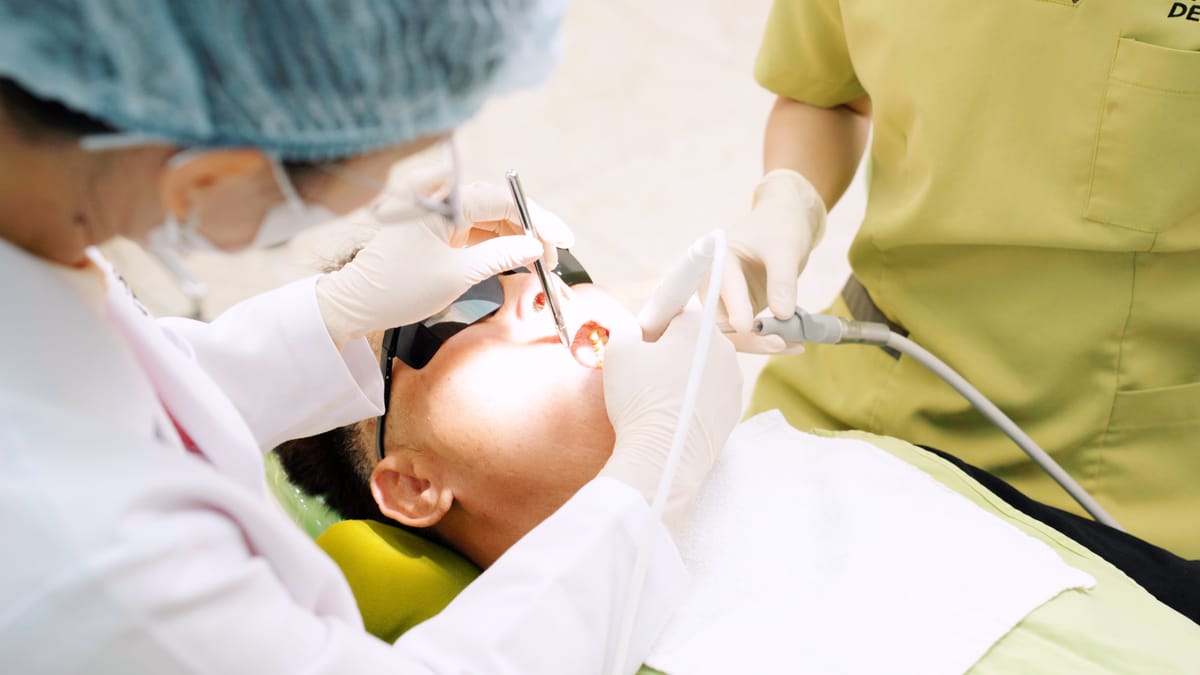
- Sterilisation: EN 13060-compliant Class B autoclaves. Single-use disposable instruments where appropriate. ADA and WHO infection-control protocols.
- Imaging: Digital intraoral X-ray and 3D Cone Beam CT (CBCT) for implant planning and bone assessment — equivalent or better than what most Western general dentists own.
- Restorative technology: CAD/CAM intraoral scanners and chairside milling for same-week crowns and veneers, eliminating the messy impression process.
- English-speaking team: International patient coordinators, English-speaking dentists, written treatment plans in English, English-language guarantee documentation.
Where Top Vietnamese Clinics Sometimes Exceed Western Norms
- Speed: Same-day or next-day consultations are routine. Treatment often begins on the second day of your trip. In Australia or the UK, you might wait weeks for a specialist consultation.
- Pricing transparency: Written, itemised quotes are standard practice for international patients. No surprise additions at checkout.
- Patient coordination: A dedicated coordinator manages your entire visit — bookings, hotel recommendations, airport transfers, follow-up by Facebook Messenger once you return home.
- Volume of complex cases: A top Vietnamese implant team may place 1,000+ implants per year. The corresponding volume at a single Australian practice is typically lower.
Where to Be Cautious
- Local-only clinics: Clinics that do not regularly treat international patients may have weaker English communication, less rigorous English-language documentation, and may not be familiar with cross-border follow-up. Stick to clinics with a published international patient program and a long track record of foreign reviews.
- Bargain pricing: If a quote is dramatically below the market rate, assume the materials are not what international patients expect. The right price band in Vietnam is roughly 30–40% of Western pricing — not 5%. See picassodental.vn/dental-costs for a realistic reference range.
- Pop-up or unverifiable clinics: Some operators run aggressive Facebook ads but have no fixed address or verifiable Google review history. Look for clinics with 1,000+ Google reviews built over multiple years.
How to Choose a Clinic That Will Not Disappoint
Use this six-point checklist before booking any Vietnamese dental clinic:
- Verifiable Google review history — at least 1,000 reviews, 4.8+ rating, with multi-year history (not 500 reviews all from the last 3 months).
- English-language treatment plan provided before you book flights — non-negotiable. Reputable clinics provide this freely.
- Implant brand and lot number documented in writing — Straumann, Nobel Biocare, or Osstem with full traceability. If they cannot name the brand, walk away.
- Fixed physical address with a verified Google Business Profile — and ideally a published team page with named dentists.
- Written warranty / guarantee in English — implants 10+ years, crowns 5–10 years, veneers 3–5 years.
- Visible international patient coordination — published Facebook Messenger, email response within 24 hours, and a process for sending X-rays remotely.
If a clinic fails any one of these checks, choose a different one. There are 5–10 accredited international clinics in Vietnam that meet all six — there is no need to compromise.
The Honest Failure Modes — and How to Avoid Them
Most “bad experiences” in Vietnamese dental tourism trace to one of three patterns:
Pattern 1: The patient picked the cheapest quote. An unrealistically cheap implant is not a Straumann or Nobel Biocare. Top implant brands carry a real cost to the clinic before any labour is added. Picking the cheapest clinic is the single biggest predictor of a bad outcome.
Pattern 2: Insufficient pre-trip planning. Booking flights before a written treatment plan exists, then arriving and discovering the clinical reality is more complex than expected. Send X-rays first; arrive with a confirmed plan.
Pattern 3: Unrealistic timeline. A full mouth of implants does not finish in one trip. Implants need 3–6 months for osseointegration before final crowns. Patients who try to compress treatment into one visit are the ones who end up with complications.
Patients who choose a top-tier clinic, send X-rays in advance, and accept a two-trip implant schedule almost universally report excellent outcomes.
Patient Outcomes — What the Numbers Show
At Picasso Dental Clinic (formerly Serenity International Dental Clinic), the 70,000+ patients treated since 2013 include thousands of international patients from Australia, the US, UK, NZ, Canada, France, Japan, and South Korea. The clinic maintains a strong Google review rating and publishes long-term implant outcome data for patients to review. The clinic provides a written guarantee program and ongoing remote support for international patients.
This is not unusual. Several other Vietnamese clinics serving international patients publish similar outcome data. The pattern is consistent: at the top tier, Vietnamese dentistry is comparable to anywhere in the world.
Frequently Asked Questions
Q: Is dental work in Vietnam safe? Yes, at accredited international-standard clinics. The clinical protocols, sterilisation standards, and materials are the same as those used in Australia, the UK, and the US. The risk is not Vietnam-specific; it is clinic-specific, and the safety checklist above eliminates the vast majority of it.
Q: Are Vietnamese dentists qualified? Yes. Dentists at top international-standard clinics hold five-year DDS degrees from accredited Vietnamese universities and many have completed postgraduate training in Germany, South Korea, the US, or Singapore. They are members of international professional bodies (ICOI, ITI, AAID) and routinely treat patients from a dozen or more countries.
Q: Will my home dentist support work done in Vietnam? Yes, in the vast majority of cases. Reputable Vietnamese clinics provide complete English-language documentation — X-rays, clinical notes, implant batch numbers, prosthesis specifications — that your home dentist can use for any follow-up. Some Australian and US dentists are initially skeptical of overseas work; once they see the documentation and quality, this concern usually disappears.
Q: What if something goes wrong after I get home? Reputable Vietnamese clinics offer written warranties (5–20 years depending on procedure) and provide remote follow-up support by Facebook Messenger or video. If a return visit is needed for warranty work, the clinic covers the clinical fees and you only need to cover travel. Picasso Dental Clinic’s Guarantee Program documents the specific coverage terms.
Q: How much does dental work in Vietnam actually cost? Costs vary by procedure, material, and case complexity — a single implant, a porcelain veneer, an All-on-4 arch, and a crown are each priced differently, and Vietnam consistently runs a fraction of equivalent Western pricing across the board. See the full 2026 price list at Picasso Dental Clinic for current figures.
Bottom Line
Vietnam is good for dental work if you choose a top-tier clinic. The savings are real, the quality is real, and the international patient program is mature. The decision is not “is Vietnam safe” — it is “which clinic do I trust”, and the safety checklist above gives you a clear answer.
→ Send an X-ray for a free written treatment plan — Picasso Dental Clinic responds within 2 hours during clinic hours.
Related Reading
- Dental Work in Vietnam 2026 Guide — Costs, process, safety, and clinic selection
- Dental Tourism Safety Checklist Vietnam 2026 — The full pre-trip verification process
- 10 Most Common Dental Tourism Mistakes to Avoid — Avoidable errors that cause bad outcomes
- 8 Red Flags When Choosing a Dental Clinic Abroad — Warning signs to watch for
- Top 10 Dental Clinics in Vietnam for Foreigners 2026 — Reviewed shortlist of internationally rated clinics
- Dental Costs in Vietnam — Full 2026 price list
- Best Dental Clinics in Vietnam for Australians 2026 — Australia-specific shortlist
- Best Dental Clinics in Vietnam for Americans 2026 — US-specific shortlist
- Patient Reviews — What our verified international patients say

Reviewed for accuracy by Dr. Emily Nguyen, DDS — Implant & Cosmetic Dentistry
Founder and Principal Dentist of Picasso Dental, with 15+ years in implant surgery, periodontics and full-arch (All-on-4) rehabilitation. Read full bio
Last reviewed: September 27, 2026