Key answer
Not all dental clinics in Vietnam have the same equipment. Here's the 7-point checklist international patients should use to verify quality before booking.
Vietnam has hundreds of dental clinics ranging from basic community practices to internationally equipped multi-specialty centers. The price difference between them can be significant — and so can the quality of care. When you’re traveling from another country for dental treatment, the stakes of choosing the wrong clinic are higher than a routine local appointment. Equipment is one of the most objective ways to differentiate clinics before you arrive.
This checklist covers the seven equipment items that distinguish a clinic capable of treating international patients to a high standard from one that is not.
1. CBCT 3D Cone Beam Scanner On-Site
A CBCT (Cone Beam Computed Tomography) scanner produces a three-dimensional image of your jaw, sinuses, bone density, and tooth roots in a single scan. For any implant case, this technology is not optional — it’s the only way to accurately measure bone volume, identify nerve and sinus positions, and design a surgical guide that places the implant at the correct angle and depth.
Clinics without on-site CBCT either refer patients to external imaging centers (adding time, cost, and coordination problems) or skip 3D imaging entirely and rely on conventional X-rays for implant planning. The latter approach significantly increases the risk of nerve injury, implant malposition, and failure.
At Serenity Dental Clinic, CBCT scanning is available in-house and is used for implant planning, complex extractions, and orthodontic assessment. Having this technology under one roof means your treatment timeline is not disrupted by external referrals, and the surgical team works from their own imaging rather than files produced elsewhere.
2. Digital (Not Film) X-Ray System
Film-based X-rays are still used in some clinics across Vietnam, particularly in smaller or less-capitalized practices. Digital X-ray systems produce images with significantly lower radiation exposure — typically 80–90% less than film — and the images are immediately available on-screen for review. Digital X-rays can also be exported electronically and sent to your home dentist.
When evaluating a clinic, ask specifically what X-ray system they use. Brand names like Carestream, Planmeca, or Sirona indicate modern digital systems. Vague answers about “modern X-rays” are not sufficient.
Serenity Dental Clinic operates digital X-ray systems with exportable imaging, which is important for patients who want their full diagnostic records available to their dentist at home after treatment.
3. Autoclave Class B Sterilizer
Sterilization is the most basic patient safety standard in dentistry, and not all sterilization equipment is equivalent. A Class B autoclave (also called a pre-vacuum or fractionated vacuum autoclave) is the gold standard for dental instrument sterilization. It uses a vacuum cycle before steam injection to ensure penetration into hollow instruments and wrapped packs — the types of instruments used in oral surgery and implant procedures.
Class N autoclaves (the simpler, cheaper option) do not reliably sterilize hollow or wrapped instruments. Clinics using Class N autoclaves may be compliant with minimum local standards while still operating below international best practice.
Ask specifically: “Do you use a Class B autoclave?” and “Do you run Helix tests or biological indicator tests?” A clinic that can answer both questions confidently is operating to a higher sterilization standard. This matters particularly if you’re having dental implants placed, where surgical instruments enter bone and blood contact is direct.
4. CAD/CAM Milling Machine or Same-Day Crown Capability
CAD/CAM (Computer-Aided Design / Computer-Aided Manufacturing) technology allows dental restorations like dental crowns to be designed digitally from a scan and milled from a ceramic or zirconia block — either in-clinic or at a connected lab. This digital fabrication process eliminates the dimensional distortions that can occur when crowns are made from conventional impressions.
For international patients with limited time in Vietnam, in-clinic or rapid CAD/CAM production means fewer appointments and faster turnaround. For all patients, it means a more precise fit with less reliance on subjective lab technician interpretation of physical impressions.
Ask whether the clinic has an in-house milling machine or uses a connected digital lab. Either can produce excellent results, but knowing the workflow helps you understand your timeline before you book flights.
5. Intraoral Camera at the Chair
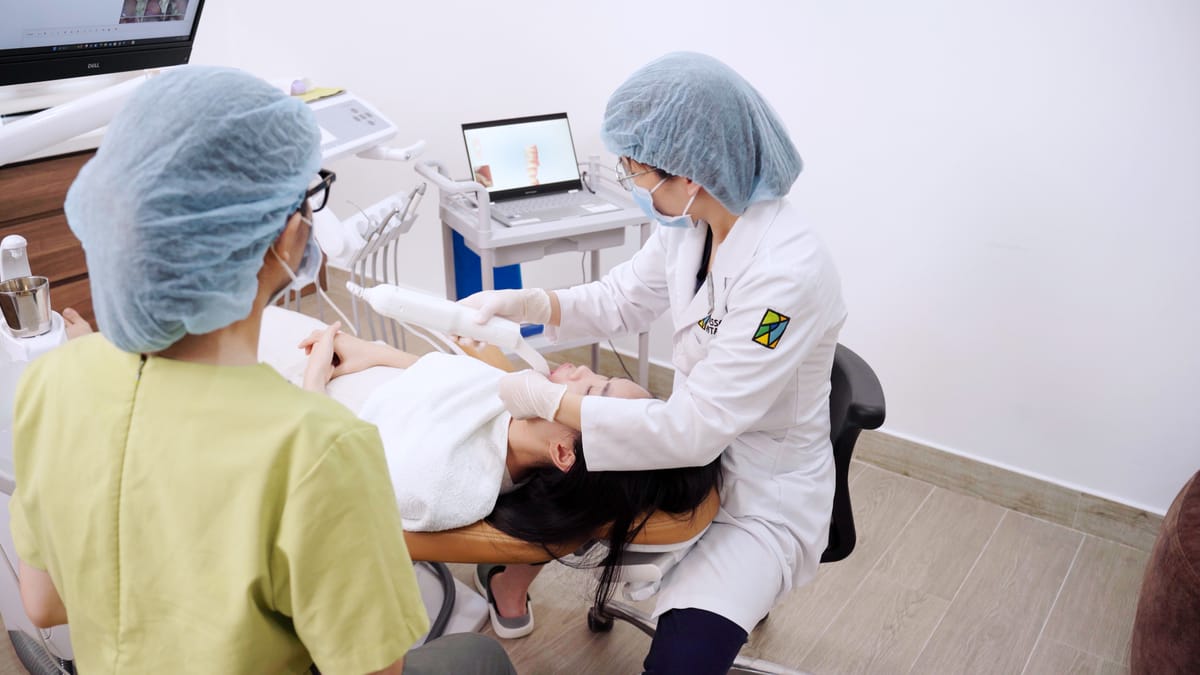
An intraoral camera is a small, wand-shaped device that captures high-resolution images inside your mouth in real time. These images appear on a screen during your examination, allowing you to see exactly what the dentist sees — cracks, decay, gum recession, worn restorations, and early-stage issues that are difficult to detect with a mirror alone.
Beyond transparency, intraoral cameras improve clinical accuracy. Dentists using intraoral cameras can document conditions at the start of treatment, providing a clear before-and-after record. For international patients, this documentation is particularly valuable — it creates a photographic baseline that your home dentist can compare against when you return for follow-up care.
At Serenity Dental Clinic, intraoral cameras are used during examinations as part of a standard diagnostic workflow. If you’re considering veneers or other cosmetic work, the before-and-after documentation these cameras provide is also useful for evaluating your treatment outcome.
6. Digital Smile Design Software
Digital Smile Design (DSD) is a planning tool that overlays proposed cosmetic changes onto photographs and videos of the patient’s face and smile. It allows both the patient and the dentist to preview how veneers, crowns, implant crowns, or orthodontic changes will look before any irreversible treatment begins.
For patients considering veneers or full smile makeovers, DSD is a significant benefit. It removes the guesswork about color, shape, and proportion — and it creates a documented treatment target that the dental lab can reference when fabricating restorations.
Not all clinics offering cosmetic dentistry have Digital Smile Design capability. When evaluating a clinic for aesthetic work, ask whether they use DSD and whether they can show you a digital preview of your proposed treatment before you commit.
7. ISO 9001 or Equivalent Certification Documentation
ISO 9001:2015 is an international quality management standard that applies to how a clinic documents its processes, handles patient records, manages equipment maintenance, trains staff, and responds to quality failures. It is audited by an independent certifying body and must be renewed on a regular cycle.
ISO certification does not guarantee any specific clinical outcome, but it does guarantee that a clinic operates according to documented, auditable procedures rather than informal habits. For international patients evaluating clinics remotely, ISO certification provides a degree of process accountability that cannot be faked — it requires third-party audits.
Serenity Dental Clinic holds ISO 9001:2015 certification, which places it in a small minority of dental clinics in Vietnam. Combined with Nobel Biocare certification and Invisalign provider status, this gives international patients a cluster of third-party quality signals that are more reliable than self-reported claims.
Before booking dental treatment in Vietnam, use this checklist as the basis for your clinic evaluation. A clinic that can answer yes to all seven items — with specific brand names and documentation rather than vague affirmations — is operating at a standard appropriate for international patients. The equipment gap between top-tier and mid-tier clinics in Vietnam is real, and the consequences of choosing based on price alone can include dental implant complications, poor-fitting crowns, and limited options for follow-up care when you get home.
Related Articles
- 7 Advanced Dental Technologies at Serenity Dental Clinic
- Why Technology Investment Earns Patient Trust
- CBCT 3D Scanning and Dental Surgery Safety
- How Digital X-Ray Reduces Radiation
- 8 Ways Intraoral Cameras Improve Your Oral Health Understanding
- CAD/CAM Same-Day Crowns: Why They Beat Lab-Made Alternatives
- ISO 9001 Certification: Why It Matters for Dental Patients
- Nobel Biocare Certification and Implant Quality
- Serenity Dental Clinic Sterilization Protocols
- How AI-Assisted Diagnosis Is Entering Vietnamese Dentistry
- Digital Smile Design: How It Makes Consultations More Productive
- Digital Smile Design in Vietnam 2026
- Why Modern Vietnamese Dental Labs Match European Quality — How Vietnam’s top labs produce results equal to Germany

Reviewed for accuracy by Dr. Emily Nguyen, DDS — Implant & Cosmetic Dentistry
Founder and Principal Dentist of Picasso Dental, with 15+ years in implant surgery, periodontics and full-arch (All-on-4) rehabilitation. Read full bio
Last reviewed: September 27, 2026