
Key answer
Supermarket whitening strips and drugstore trays seem convenient but they pale against professional in-chair treatment. These 5 clinical differences explain why the chair is always the better investment.
Walk down any pharmacy aisle and you will find a wall of whitening products: strips, trays, paint-on gels, whitening toothpastes, and LED kits. They are marketed with confidence. The results are inconsistent.
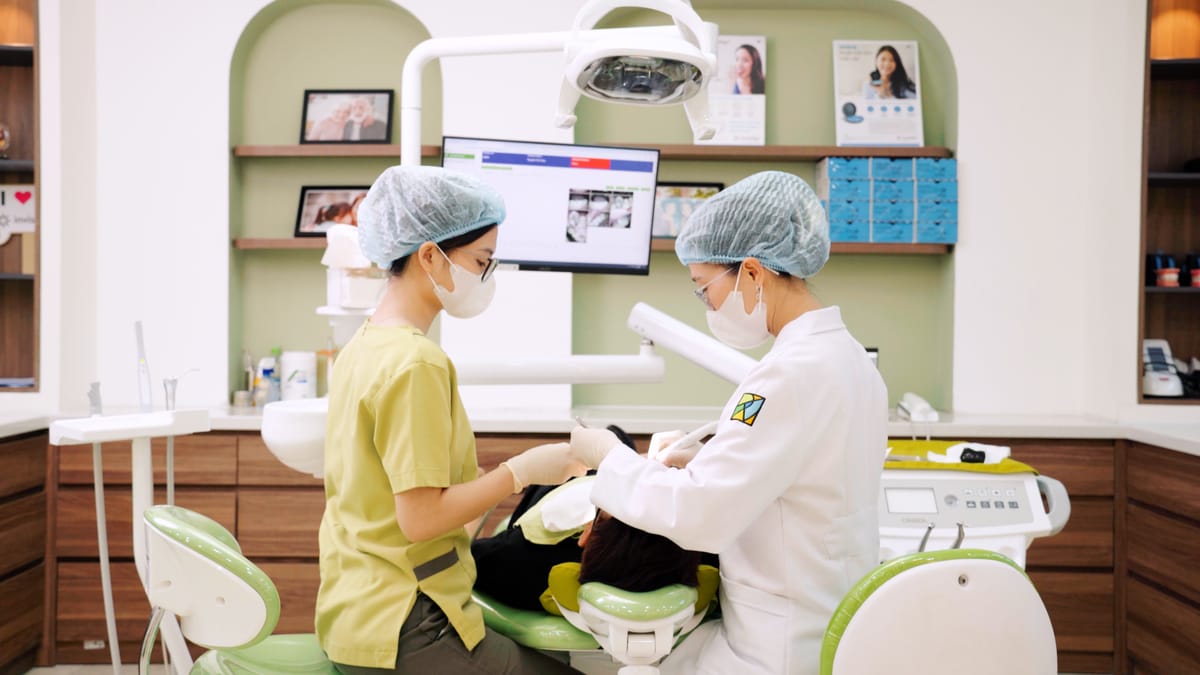
Meanwhile, in-chair professional teeth whitening delivers predictable results in a single appointment. There are five clinically meaningful reasons why professional whitening consistently outperforms over-the-counter products.
Reason 1: Professional-Grade Peroxide Concentration
The most important variable in teeth whitening is the concentration of the bleaching agent. Higher concentration means more oxidising power, which means more stain molecules are broken down in a shorter time.
Over-the-counter products are limited to 0.1% to 6% hydrogen peroxide. In-chair whitening uses 15% to 40%. At 35%, the treatment operates with roughly five to thirty-five times the active ingredient of a supermarket strip.
The result is that in-chair treatment achieves in one to two hours what would take weeks of consistent at-home use, and often achieves a final shade that consumer products cannot reach.
Our post on teeth whitening options in Vietnam covers everything from consumer products to in-clinic systems.
Reason 2: Custom-Fitted Trays Prevent Gel Leakage onto Gums
One of the most common side effects of over-the-counter whitening is gum irritation. It is caused by gel leaking out of poorly fitting trays or strips and contacting the soft tissue of the gums.
Consumer strips are cut to a generic size. Tray kits use one-size trays that cannot conform precisely to your teeth. The result is gel on your gums, which causes chemical irritation and sometimes significant discomfort.
In-chair whitening uses chairside-applied gel and custom-made barriers to protect the gingival tissue. We use cheek retractors, gingival dams, and precise gel application to ensure bleaching agent contacts only the enamel surfaces being treated.
The practical outcome is that properly supervised in-chair whitening produces less gum irritation than consumer products — the opposite of what most patients assume.
Reason 3: Light and Laser Activation for Faster Penetration
Many professional whitening systems use a light or laser source to activate the bleaching gel. Light energy excites the peroxide molecules, generating more reactive oxygen radicals in a shorter period.
Consumer LED kits emit significantly less energy than professional systems and are used with low-concentration gels. The activation effect is present, but the low peroxide concentration remains the limiting factor.
In a professional setting, you have high-concentration gel, a calibrated professional light source, and a controlled treatment time — all three variables optimised simultaneously.
Reason 4: Dentist Oversight Managing Sensitivity
Tooth sensitivity during and after whitening occurs because peroxide molecules temporarily penetrate the enamel and dentinal tubules. In most patients it is mild and transient.
With consumer products, you are managing this alone. With in-chair whitening, your dentist assesses your pre-treatment sensitivity, identifies risk factors, and adapts the protocol accordingly. After treatment, prescription-strength fluoride or desensitising gel can be applied immediately.
Our post on tips for maintaining teeth whitening results includes guidance on managing sensitivity between sessions.
Reason 5: Longer-Lasting Results with Professional Conditioning
The results of in-chair whitening last longer than those of consumer products for two interconnected reasons.
First, the higher concentration of professional whitening penetrates deeper into the enamel structure and breaks down more intrinsic stain. Consumer products primarily remove surface staining. When the underlying enamel colour has been more thoroughly addressed, visible staining takes longer to accumulate.
Second, professional whitening is paired with post-treatment conditioning. Immediately after bleaching, the enamel is transiently more susceptible to staining. A professional can apply remineralising agents and give you specific post-treatment guidance.
Our post on foods and drinks that stain teeth faster gives you the practical list of what to avoid during the post-whitening window.
The Bottom Line
Over-the-counter whitening products operate with lower concentration, without gingival protection, without clinical monitoring, and without post-treatment care. In-chair professional whitening is a clinically distinct procedure that achieves outcomes consumer products cannot replicate.
If you are in Hanoi and considering whitening, visit our teeth whitening service page to understand what a professional treatment involves and what results are realistic for your specific situation.

Reviewed for accuracy by Dr. Emily Nguyen, DDS — Implant & Cosmetic Dentistry
Founder and Principal Dentist of Picasso Dental, with 15+ years in implant surgery, periodontics and full-arch (All-on-4) rehabilitation. Read full bio
Last reviewed: October 25, 2026